Courtesy of LoveYourBrain Foundation
By Eliza Marie Somers
Do you have trouble falling asleep at a reasonable hour? Do you wake up in the middle of the night and can’t get back to sleep? Is your inner critic or “monkey mind” keeping you awake?
You are not alone if you answered yes to any of these questions. Roughly 50 million to 70 million Americans have trouble sleeping or about 30 percent of the population, according to HelpGuide.org. And sleep issues are quite common after a traumatic brain injury with 30 percent to 70 precent of TBI survivors experiencing problems falling asleep, “many occurring after mild injuries,” a recent study found.
- https://pmc.ncbi.nlm.nih.gov/articles/PMC3482689/
- https://msktc.org/tbi/factsheets/sleep-and-traumatic-brain-injury
To help brain injury survivors, the Brain Injury Hope Foundation’s June 12, 2026, Survivor Series: Yoga Nidra for Sleep and Mental Health after Brain Injury featured yoga instructor and program director Bridget Hearne of the LoveYourBrain Foundation.
However, don’t be fooled by the word “yoga,” as yoga nidra is a non-movement relaxation technique that is scientifically proven to help calm the nervous system, thus making it easier to fall asleep, ease anxiety, relieve depression and rewire the brain.
“My ultimate goal for today is that you leave here with this new understanding of how yoga nidra can help foster healing and resilience in a new way forward after a brain injury, and especially how it can support with some specific things like sleep and mental health,” Hearne explained.
What is Yoga Nidra?
Yoga Nidra is described a yogic sleep. “Yoga Nidra is an evidence-based, guided meditation technique,” Hearne said. “It's been proven to improve sleep, improve a lot of other conditions like PTSD, symptoms like headaches, anxiety, depression, specifically after a brain injury.
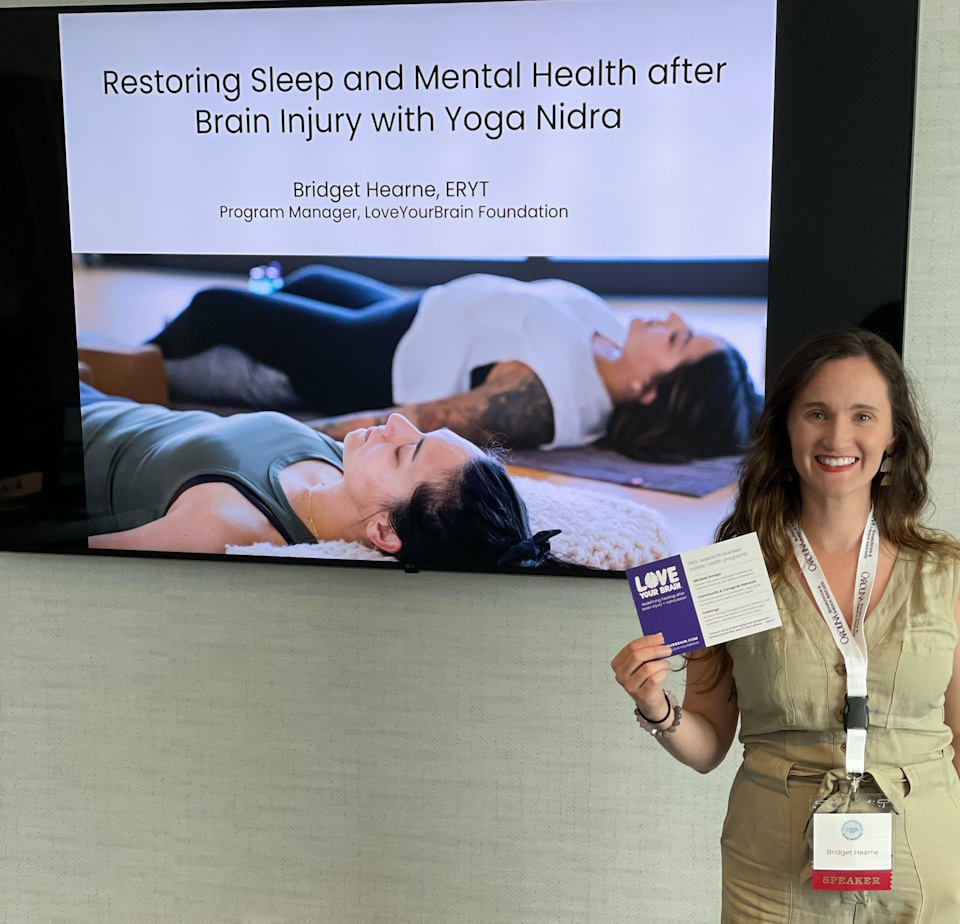
Program director for LoveYourBrain Foundation Bridget Hearne says yoga nidra can help brain injury survivors by improving sleep and relieving headaches, anxiety and depression. Courtesy of LoveYourBrain Foundation
“We hear the words yoga a lot, and we think about moving the body around, or stretching the body, or of physical exercise, and that is part of a lot of different forms of yoga. … Whereas yoga nidra is a form of meditation. So, there's not a lot of physical movement involved. There is an awareness of the physical body, but not a lot of the movements like you see in other forms of yoga.
“What the research has shown is that Yoga Nidra actually works with our brainwaves,” Hearne continued. “It works to specifically shift our brainwaves into the frequencies that allow us to access deep rest. … Yoga Nidra promotes this really, deep state of relaxation, and it's referred to as the hypnagogic state. It's the state between being awake and being asleep.”
As with any yoga, it’s a personal practice, and each person and instructor may have different experiences and protocols. Some Yoga Nidra practices encourage sleep while other instructors inspire practitioners to stay awake. Yoga Nidra also can be practiced while lying down or in a chair.
Hearne explained that the brain enters a state of really deep relaxation in Yoga Nidra that is similar to sleep and mimics sleep, however, it’s more like a “conscious rest.”
“We're making a conscious decision to let our brain rest,” Hearne said. “So, that's what really sets Yoga Nidra apart from many other forms of meditation. There are traditional mindfulness meditations where the mind stays really alert and focused, but in Yoga Nidra, we have this specific protocol that really lulls the mind into this deep state of relaxation.”
Traditional yoga nidra protocol:
- Set an intention or sankalpa
- Find an inner source
- Body scan
- Breath awareness
- Emotions and feelings awareness
- Witness thoughts and beliefs
- Intention and open awareness
Hearne broke down the protocol steps and the reasoning behind them.
Setting an intention is liken to planting a seed and serves as an anchor for the practice. It should be in the present tense and short, such as I am strong. I am healthy. I fall asleep easily and wake up refreshed (if using for sleep).
“Turning our energy away from where we don't want it to go, and then pointing it, directing it, where we do want it to go,” Hearne said.
Identifying an inner resource can be an image or thought that promotes a sense of safety or ease that the practitioner can return to during the session.
“This is something that I think people don't talk about a lot,” Hearne said. “Sometimes meditation can bring up some difficult emotions, especially when you first start practicing. So, we always encourage people at the beginning of a practice to set an inner resource, some memory, some thought, some image that you can bring to mind if you start to feel those difficult emotions, and you just need something to come back to.”
Scanning the body helps create the mind-body connection, and the breath awareness and controlling the breath helps regulate the nervous system. After that the protocol encourages people to observe thoughts, emotions and beliefs.
“This creates a space more for self-inquiry,” Hearne said. “And then finally, we allow folks to kind of rest in a deep state of relaxation. So just no words – nowhere to be -- nothing to do, just this state of being.”
Benefits of Yoga Nidra
Improving and helping people achieve deep sleep is one of the more recognizable benefits of Yoga Nidra. And while Yoga Nidra can mimic sleep it is not a substitute for sleep.
“Sleep is something that can be largely impacted after a brain injury,” Hearne said. “We all know how important sleep can be, how important rest is for recovery. And so, when you have that foundation of poor sleep, that can just undermine the recovery and creates a domino effect. It just kind of exacerbates all the other symptoms we have. So, it's really important that we address these issues, especially the issue of sleep. And that is where Yoga Nidra comes in.
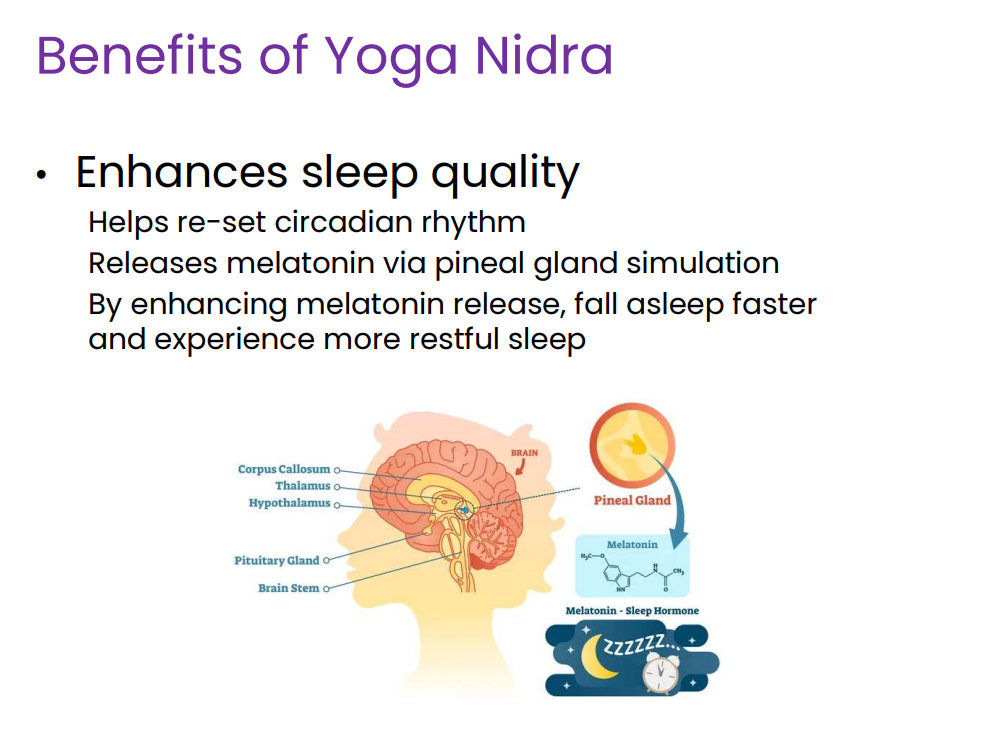
“I think it is probably the most profound benefit of Yoga Nidra, because sleep is such a critical foundation for everything else,” Hearne continued. “By guiding the body into this deep state of relaxation, Yoga Nidra, in some ways helps to reset the circadian rhythm, and stimulates the release of melatonin. That's a key hormone for restful sleep, especially the natural melatonin that your body makes.
“The rest that your brain is able to access from practicing Yoga Nidra is being compared to the rest your body would get from about three hours of sleep. So, I'm excited to see what that research actually comes out to. It just speaks to how powerful it is to supporting rest, and how important rest is to supporting everything else in our lives.”
Automatic negative thought (ANTS) patterns and rumination can be intensified after a brain injury, and yoga nidra can help TBI survivors break these destructive patterns.
“These negative thought patterns can become really deep and unconscious,” Hearne said. “What that means is that they happen without someone even trying to think them. People kind of get stuck in this loop of feeling like, no one cares; they might feel hopeless depending on what their situation is; they might feel like something's wrong with them.
“This loop just continues, and then this just exacerbates all of the other symptoms. It's kind of like how poor sleep exacerbates everything else. These negative thought patterns just exacerbate all of our other symptoms leading to poor sleep, anxiety, depression.”
Hearne credited neuroplasticity -- the brain’s ability to adapt, reorganize and create new connections -- in helping the brain break these ANTS, and yoga nidra’s ability to facilitate neuroplasticity.
“In yoga therapy, the idea of neuroplasticity is explained by what's called a samskara. The word samskara is the mental imprint that your mind receives through thoughts and through actions,” she said. “So essentially, each time we have a thought, each time we have a thought pattern, and each time we return to it, we're really just reinforcing all of those neural pathways in our mind that kind of validate that thought pattern. … When we take into account these negative thought patterns typically or very often do accompany a brain injury.
“Those habitual and recurring thoughts are only being strengthened and reinforced by returning to them. We need to interrupt these negative thought patterns and create new and more helpful ways of thinking. And that really is the power of Yoga Nidra, and specifically that first step I mentioned -- setting an intention. Planting new seeds.”
Other benefits of Yoga Nidra are reducing muscular tension, decreasing anxiety and stress, relieving symptoms of depression by lowering cortisol, and releasing calming neurotransmitters such as GABA, melatonin and serotonin.
Brain Monitoring Reveals Yoga Nidra’s Benefits
Ongoing research on Yoga Nidra continues, however, one study Hearne referenced showed how brainwaves change during a Yoga Nidra session.
Five Brainwaves Explained
-
- Gamma (30+ Hz) – The fastest brainwaves, linked to peak focus, higher cognitive function, learning, retrieval
- Beta (13-30 Hz) – Attention, problem solving, decision making
- Alpha (8-13 Hz) – Meditation, mindfulness, light daydreaming
- Theta (4-8 Hz) – Rapid Eye Movement (REM) sleep, light sleep
- Delta (0.5-4 Hz) – Non-REM sleep, deep, restorative sleep
“One thing I like to emphasize about these brainwaves is that typically we're not just in one state or the other,” Hearne explained. “The brain can experience multiple states at the same time. And brainwave activity is not uniform across the whole brain, so different regions of the brain that are responsible for different processes, different experiences, (the brain) can be experiencing different types of brainwaves at the same time. In Yoga Nidra the brain operates as if it's in deep sleep … Yet, you're still cognizant of your experience, even if you don't remember it.”
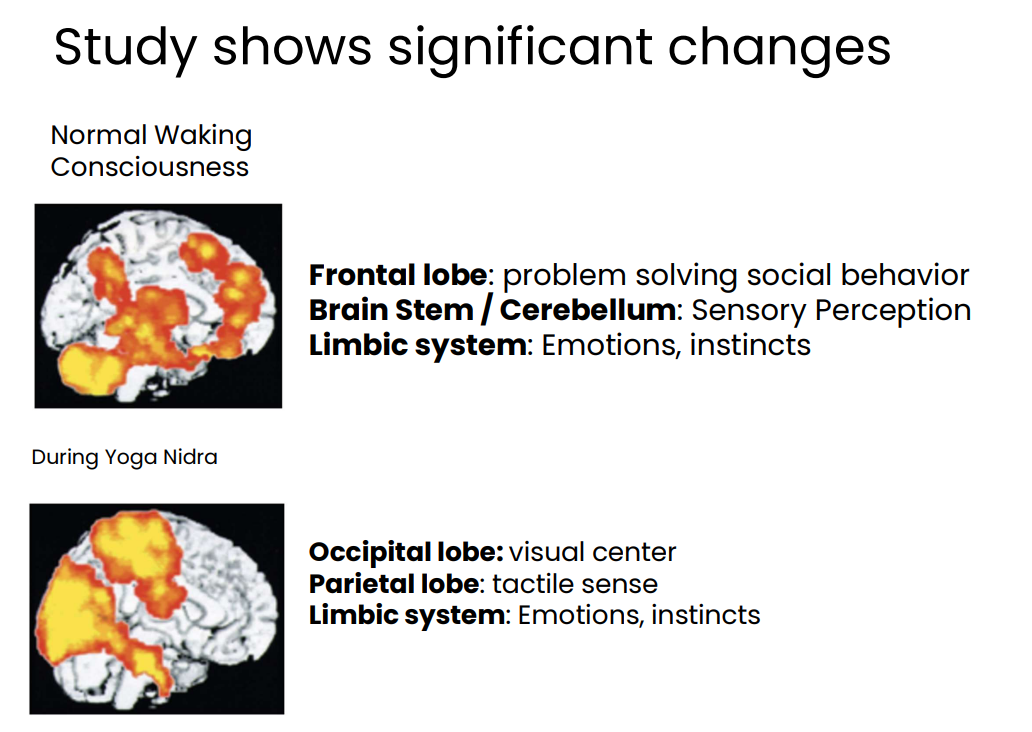
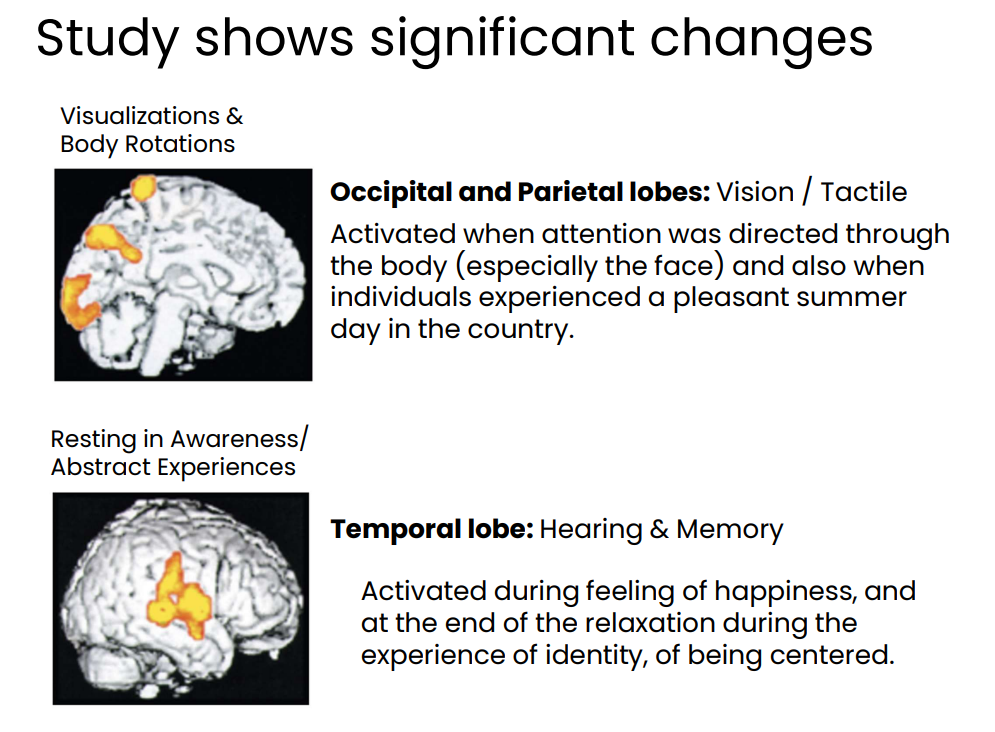
Hearne then showed slides of a research study involving seven people practicing Yoga Nidra while hooked up to an EEG machine to measure brainwaves while also undergoing at PET scan to show what parts of the brain were active during the different stages of Yoga Nidra.
Courtesy of LoveYourBrain Foundation
The study revealed that the frontal lobe of the brain, which controls executive functions, such as planning and decision-making, was not active during Yoga Nidra. The parts of the brain that were active control visual and emotional processing
The last photo Hearne showed was the brain in the deepest point of Yoga Nidra.
“We see that the temporal lobe (auditory and encoding memory) was particularly active here, and this is associated with empathy, with compassion, with perspective taking,” she explained. “The main takeaway of all of this is just noting the ability for individuals to be both in this deep state of relaxation while still having some control over the brain's activity with a pretty high degree of concentration. Some people describe it as this feeling of almost effortless concentration.”
Courtesy of LoveYourBrain Foundation
When to Practice Yoga Nidra
Many people use Yoga Nidra to lull them to sleep by releasing muscle tension and quieting the busy mind. Others like to practice during the day to halt fatigue and rumination.
“A lot of people benefit from more of a midday practice, especially to support cognitive fatigue,” Hearne said. “Again, as I mentioned, there's a lot of great research that hasn't fully come out yet, but it indicates that getting in a Yoga Nidra practice that rest can be equivalent to three or so hours of sleep. So, this can be really supportive midday if you feel an overwhelm of fatigue or cognitive fatigue to take a moment to allow yourself to access this deep rest.”
Yoga is described as a practice, and it’s the continued practice that can have the most profound impact on a TBI survivor’s life and recovery.
“That accumulation of practicing it over a period of time is eventually going to allow you, hopefully, to access some more meaningful sleep before bed.
“When we train our muscles, when we train any part of our physical body, we see the benefits over time. And it's the same way with meditation, any kind of mental or mindfulness practice, we're training our minds to be able to access this rest and this mindfulness. The more we practice, the stronger it'll get.”
FREE Resources for Yoga Nidra
- LoveYourBrain Foundation
- Insight Timer
- iRest
Link to LoveYourBrain PowerPoint Presentation
