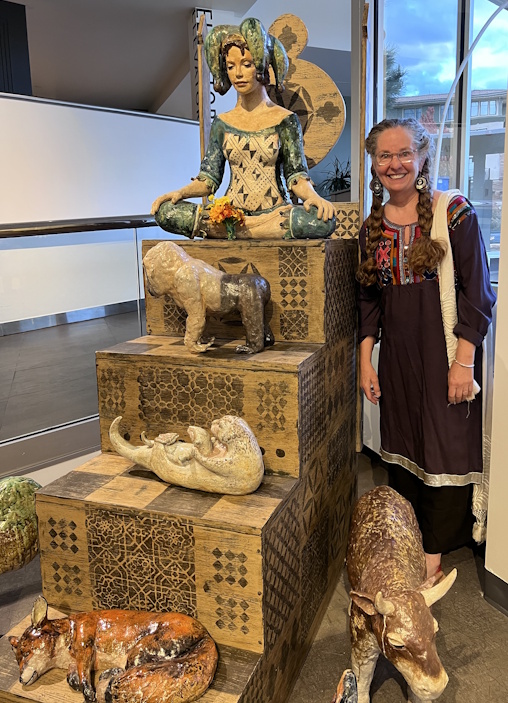
Ceramic artist Caroline Douglas with some of her artwork says creating art helped her heal from a traumatic brain injury. Visit https://www.carolinedouglas.com to see more of Caroline Douglas’ art.
By Eliza Marie Somers
Being vulnerable is scary, however, it might be the magic sauce that helps brain injury survivors in their pursuit of new and successful possibilities.
During the October 10, 2025, Survivor Series: Innovative Ways to Create a New Life and Positive Experiences, the panelists related how they stepped out of their comfort zones to tackle the maze of therapies and create a successful life after traumatic brain injuries.
Vulnerability in a person is the state of being open and honest about their emotions, thoughts, and needs, often despite a fear of rejection, judgment, or misunderstanding.
In 2017 TBI survivor and panelist Jena Taylor suffered a “whopper” of a brain injury that sidelined her life as she had to learn how to walk and talk again. At the time of her injury, she was living alone and needed help with her recovery. She experienced how vulnerable she was when she called her mother to enlist her help. However, Taylor did not find support from her mother.
“It was devastating,” Taylor said. “I made a phone call to my mom, who lived in Arizona. I was living in Denver at the time. And I told her about my accident, about my status, and that I couldn't do anything for myself, and could she please come and help me. And the answer was, ‘No. I couldn't possibly leave my life, just because you're having a crisis.’ And that was very, very difficult. It was extremely painful, and it was shocking.
“And then she kept calling, and my neurologist kept saying, ‘Stress is your biggest enemy with recovery. Eliminate any and all stress.’ And I kept warning my mom that if she was going to continue to contribute to my stress, which was a detriment to my recovery, then she couldn't be in my life. And as hard as that was for me, I did say it. I did stick to it. And my mom and I didn't speak for three years. No communication whatsoever.”
Fast forward to today, and Taylor and her mom are on speaking terms.
“We made peace,” she said. “It’s a part of my life that was very painful.”
Taylor is not alone in finding stress in relationships after a TBI, as friends and family members may not understand the “hidden” symptoms of TBI and they may be unsure how to help so they drift away, leaving survivors to fend for themselves.
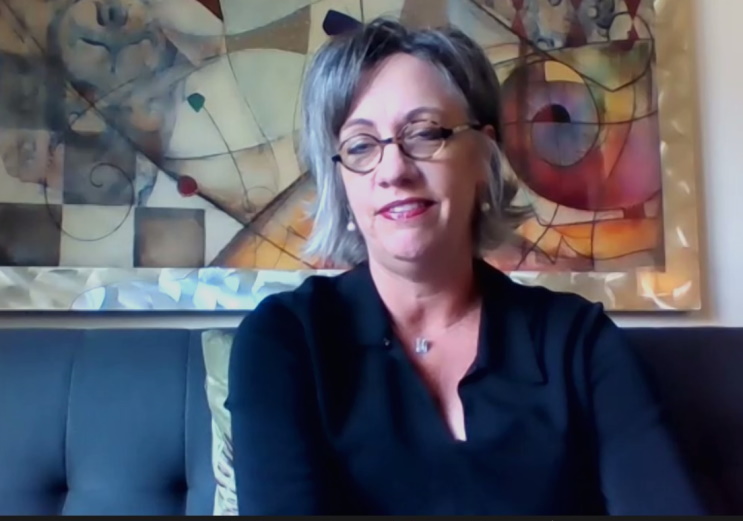
Jena Taylor says she relied on her resiliency and her day-to-day dedication to therapy to heal from a TBI.
Taylor found help from her friends and the Brain Injury Hope Foundation team.
“I had a village helping me; a really excellent care team, and the Brain Injury Hope Foundation. (BIHF vice president Joanne Cohen) was the first person that really kind of gave me some hope. … that really catapulted me into this position of thriving.”
Taylor’s mindset was that her recovery was a full-time job as she navigated her way through numerous therapies, including physical therapy, cognitive therapy, vision therapy, vestibular therapy and occupational therapy to name a few.
“How did I rebuild my life? I did it day by day,” Taylor explained. “A series of small events, or, like in the very beginning stages of my injury I was inundated with therapies. … My recovery was a full-time job. I was committed to it like it was my full-time job. I made a decision early that I was going to give it a full year. I would go into debt; I would spend as much money as I had to, and after the end of the year, I was going to decide and evaluate: Can I do what I did before? If not, what can I do? Because living like that wasn't going to work for me.
“It wasn’t even the end of the year and I was back on track. I was making six figures, and I was writing copy for IBM Watson Health. So, I had a dramatic recovery. It didn't seem like it at first, because it was so slow, it was so slow. And I just focused on every therapy, and like I said, I did it like my life depended on it.”
Taylor’s dedication and a workman-like approach to her therapies catapulted her recovery. However, it was her resilience that she cultivated from numerous events such as her apartment flooding twice, an abusive relationship and her service dog dying right before hip surgery, that put the icing on top of her recovery cake.
“A lot of these things happened, and I would take it back to ‘I am resilient. If I can survive this, I can survive that.’ I just kept digging deeper and deeper and deeper. Everyone around me was like, ‘How in the hell can you do this? How are you still smiling? Why are you joyful? Why aren't you curled up in a corner somewhere just giving up on life?’ And I just said, ‘That's not an option for me. You know, I'm resilient.’ I took this resilience and I have actually switched gears; I'm still a marketing strategist, I'll always be a salesperson, but I'm also a resilience strategist, and I've launched an entire new brand under my Word Tailor company, and it's to help people build that resiliency muscle.”
Resilience: the capacity to withstand or to recover quickly from difficulties.
Taylor’s new venture – Resilience Brilliance https://www.resiliencebrilliance.co/ – helps people build “that resiliency muscle.”
“Life is turbulent. Life is messy. It's hard. So, I teach people these tools that I've learned through my study and my own experience to be able to tap into those skills and build that resilience muscle so that we can handle and cope with these things that life gives us. … We have to flex that resilience muscle all the time.”
So how do you flex the resiliency muscle?
“Despite our limitations, if we do work on things daily, in small bits, then we become stronger, and our situation improves. …There is no cap on our resilience, and learning to grow.”
Healing Through the Arts
Artist Caroline Douglas became vulnerable when she decided to come back after a near death experience after her brain injury. While helping her daughter decorate a gym for her 8th grade graduation, Douglas was on a cherry-picker extension ladder when it gave way and crushed her skull.
“It collapsed onto my head… my head was between the cage and the ladder… and I had a moment of OK; I need to be really aware; this is a very important moment. Time slowed down. And as the thing started falling over, I --this may sound kind of funny -- but I left my body,” Douglas explained. “I went to the corner of the room, and I was watching down from the corner as my head was crushed and my body fell. So, I took this extremely long moment where I felt like everything is totally fine. There is nothing to worry about, the world works itself out, everything is perfect. And I was surrounded by white light. I didn't see a tunnel, but it just was, like, bliss. It was very blissful. …
“So, in this state, I was looking down at that body, and blood was all over the floor, and I heard a voice inside my head say, ‘You have a choice.’ And I took another long moment, and I looked at that body and thought, I'm not so sure. But, as soon as I sort of panned the room, and I saw my son, who was 9 years old at the time. He was holding his lunchbox, and he was staring at my body. And so, I said, I really want to stay for him.”
After more than two years of numerous therapy sessions and still having difficulty with sleeping and speaking, one of her doctors encouraged Douglas, who has a degree in ceramic arts, to start creating art again.
“At that point, I think I had two frozen shoulders and a broken hand, and my husband would put the clay out on the table, and I would just make these things. … After I was able to sleep through the night, I started having dreams of these pieces that wanted to be made with urgency.
“And in the making of these clay pieces is where my brain started coming back, and I could tell I was getting better.”
Douglas’ art pieces reflected her recovery. In “Babbel” Douglas said the letters above her head resembled the fact that she could not form letters into words.
“Working with the clay gave me time alone in the quiet space,” she said. “Motor skills were able to come back as I did this.”
Douglas described one of her works that she saw in a dream that depicted an elephant head and she is under the head. “The reason that dream came to me was because whenever I would try to go to the grocery store, I would be overwhelmed with the lights and the people talking to me, and I would faint, so I felt like I had to become bigger than I thought I was instead of shrinking. I can take up some space here.
“In the making of these pieces, I felt healed. I felt I was in flow,” she said. “My brain was relaxed. My hands were working; there was some vessel channeling thing happening.
“Most of the time that I wasn't working in clay, I was so anxious. I was a nervous wreck. But when I worked with clay, it made it safe for me to come into my body. And I made all of these women with their eyes shut, with these extremely serene. expressions. As I made them, I became them. ... I feel like that was a huge part of my healing.
“It's kind of like a magical thing that happens with me and clay, and I think it can for a lot of people.”
A big part of Douglas’ recovery was her family. “My family was so, so supportive. Honestly, I felt like I was surrounded by angels,” she said. “I felt like I had to re-meet my friends, because I just couldn't show up for them, but my family was there for me.”
Douglas’ psychic abilities started when she was younger, and were further enhanced after her TBI.
“I felt one foot in this world, one foot in that world, and the dreams at night. … The finished piece would show itself on a lazy Susan in the round, and I would see all sides of it. And I would wake up, and I would just get the clay, and start making.”
Douglas said she went to school to learn how to deal with her psychic abilities and learned “how to ground and take care of my energy more, and then I started teaching energy tools for people with head injuries. After that, I started showing my work and teaching about creativity as a healing tool. … I was asked to travel all around the world, Morocco, Mexico, Latvia, all over teaching people how to find their own joy and creativity. And it could be in any medium, but mine just happens to be clay.”
Use the Brain to Heal the Brain
Physical therapist Mary Pavlantos dedicated her life to helping brain injury survivors after her father suffered a TBI in a rollover accident when she was in high school. The resulting injury caused her father to lose the family business and the family home.
“We lost everything, so I was left figure out life on my own at 18, and so I just dedicated my career to helping people with brain injuries,” Pavlantos said.

Physical therapist Mary Pavlantos is healing alongside her patients as she recovers from a brain injury due to COVID-19. Her company is Roots Physical Therapy and Wellness https://www.rootsptandwellnessco.com.
After receiving a Doctor of Physical Therapy degree and a Bachelor of Science degree in Kinesiology and Leisure Science Pavlantos worked at Craig Hospital treating brain injury survivors.
But her career was put on hold in 2021 after she almost died of COVID-19 and has since suffered from long haul COVID in which the virus attacked her brain and nervous system causing encephalomalacia and organ failure.
“It's been a journey dealing with the brain injury and all the organ failure issues because of this virus, but I'm determined to get better. I'm a single mom, I'm a business owner, I just could relate so much to Jena’s story of being alone and figuring this out. … So, I better rally in the troops here and figure out how to get better.”
Pavlantos experienced the loneliness of losing friends when she needed them the most.
“A lot of my friends ran in the other direction, which I'm sure a lot of you can relate to,” she said. “You just figure out who those people are that are going to pull together to have your back and see you for your true self … despite having all these weird symptoms happening to your body.”
Pavlantos is still rebuilding her life after just recently having another hospital stay in the summer and continuing numerous therapy sessions, including biofeedback.
“My biggest motto is use the brain to heal the brain,” she said. “And sleep is obviously a huge component. I use the charging the phone analogy, and too many apps are running, and we got to close some apps, and take brain breaks.”
Pavlantos said she has seen the miracle of brain neuroplasticity in her work as a therapist. She related a story of a young patient who was violent after a TBI and within three months of working with him he gave her a big hug and a scarf and gloves.
“He said ‘Dr. Mary, thank you for helping me heal my brain.’ And that was the moment I was like, oh my God, neuroplasticity is no joke.”
Thus using the brain to heal the brain.
“I usually explain neuroplasticity like a traffic jam, or a disconnect in the neurons, and they're just not connecting. Those brain farts, if you will. You're just re-patterning by practice to reconnect those networks, and sometimes they just don't reconnect. That's when you have to adapt and use reminders, calendars, and sticky notes. You got to use your tools. Very often, if you repeat and practice, a new neuron network will connect and recreate that pathway that got injured.”
After her brain injury Pavlantos said she has changed her approach to physical therapy when working with patients.
“I'm just not so pushy on the home exercise program,” she said. “if you get to it for less than three minutes, go ahead and try before you go to bed, and then just go to sleep. … If you have trouble focusing near and far, then do that three to five times as your exercise, or if you get dizzy when you turn a corner, stop, take a deep breath, and go repeat that same thing three to five times. So, I just integrate more functional retraining into life.”
“It's been very interesting, because healing alongside my patients has been a totally different experience, and it's just shown me so much more that I didn't see before, because it was so black and white … now the level of empathy is just completely different.”
Pavlantos leaned on her faith to help her through her recovery.
“My biggest tools in my darkest days were my faith in a higher power. I call it God, call it whatever you want, but the environment, nature, trees, the sun, the birds, using Mother Nature and Earth,” she said “Just trying to find as much happiness and peace where you can, and things that give you that. And absolutely taking out all of the toxins like, sugar, alcohol and toxic people. It really will allow you so much more peace and comfort and tranquility if you can get rid of those toxic relationships and substances. … Find your healthy tools.”
Final Thoughts and Useful Articles
Mary Pavlantos: One patient told me if you have one foot in the future and one foot in the past, you're pissing on the present. So, I would say live in the now.
Brain Injury Recovery Guide by Mary Pavlantos.
Jena Taylor: Stay the course. Reframe adversity, because it fuels your growth. No matter what life throws your way. Mindset is so important as we go through anything in life, and healing from a traumatic brain injury is traumatic.
Caroline Douglas: Find what delights you and follow that. Trust yourself. Trust your spiritual self, trust your physical self, and show up for what brings you joy.
